The Batteries of the Future | Professor Robert House
Keble Fellow Professor Robert House is the Principal Investigator of 3D-CAT, a new £3 million project backed by the Faraday Institution aiming to revolutionise lithium-ion battery cathode technology.
The University of Oxford is working in collaboration with UCL and a consortium of industry partners to develop high-performance cathode materials that avoid reliance on cobalt and nickel, elements fraught with cost, environmental and supply chain challenges.
3D-CAT will focus particularly on lithium-rich disordered rock-salt materials. These promise high energy density but have so far struggled with poor rate performance (charge and discharge) and limited scalability.
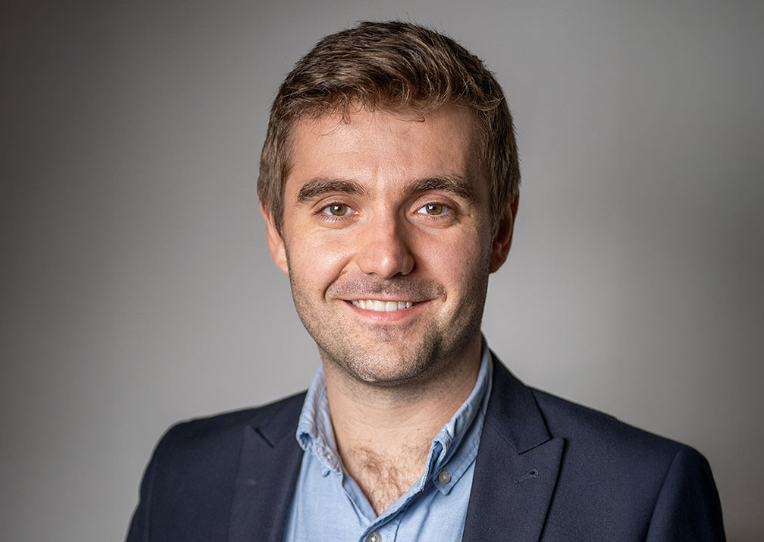
Professor Robert House. © Robert Spanring
Over the three years of funding, the team will progress from design to prototype fabrication and validation. They will develop new fundamental understanding on the atomic-scale structure of these three-dimensional rock-salt materials, engineer optimised particles, and develop scalable manufacturing routes.
Professor House commented: “To gain a competitive edge in the global battery race, the UK needs to develop novel Li-ion cathode materials that can be made using locally sourced minerals. The 3D-CAT project will deliver on this mission by leveraging world-class science and our expert industry partners to develop a new class of high-performance 3D cathodes for the British battery industry.”
Professor House specialises in novel sustainable energy materials, particularly for electrochemical energy storage. His group’s prior work spans lithium and beyond-lithium battery chemistries, using advanced scattering techniques to probe ion transport and structure–function relationships.