Complexity Cluster Workshop
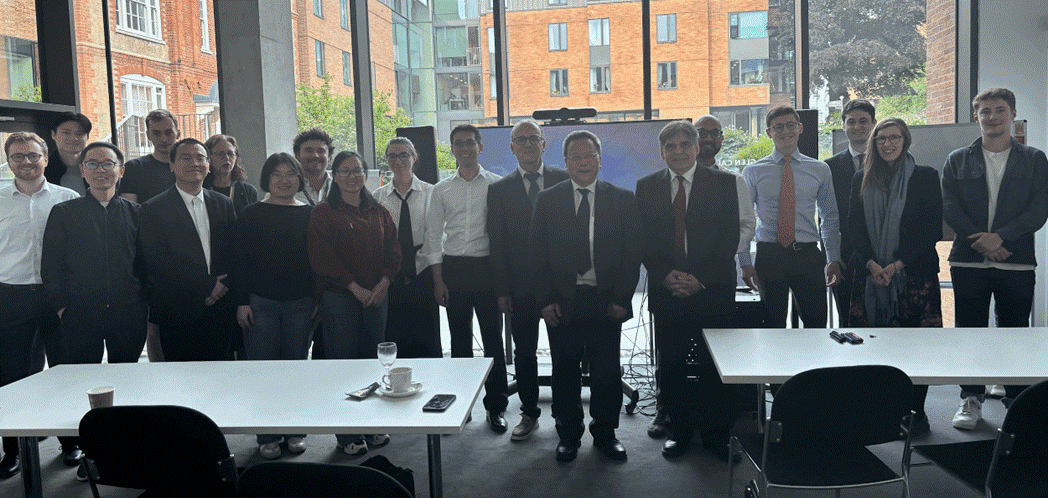
In Trinity Term, Keble hosted a Complexity Cluster workshop that brought together mathematicians from a broad range of research areas to share their work. Part of a successful ongoing series of workshops at Keble, the event was organised by Professors Gui-Qiang G Chen (Professorial Fellow in Mathematics), Helen Byrne (Professorial Fellow in Mathematics), and Mohit Dalwadi (Tutorial Fellow in Mathematics). Four speakers gave talks showcasing their research in a clear and engaging way, to an audience made up of academics, postdocs, DPhil students, and undergraduates from across the mathematical sciences.
Professor Didier Bresch
Mathematical Topics around Granular Media
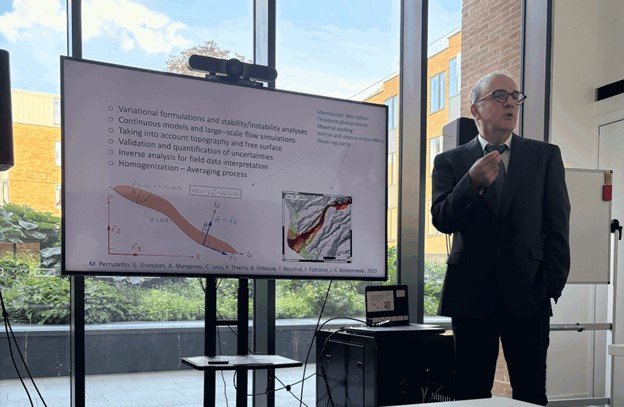
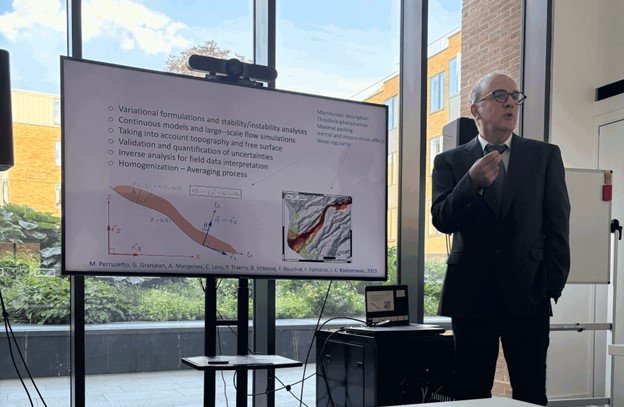
Professor Bresch introducing open problems in modelling granular media
The first talk explored how Partial Differential Equation (PDE) models and mathematical tools can help us understand complex movements in granular materials like soil, sand, and mining waste. Professor Didier Bresch introduced his ComplexFlows project at CNRS, which studies how the ground shifts in events such as landslides, volcanic activity, and industrial accidents. He began with real-world examples, including the 2019 collapse of a mining dam in Brazil that released millions of cubic metres of waste, highlighting why better prediction tools are essential.
He then showed how challenging these problems are, drawing on work with geophysicists and numerical analysts. Granular materials behave unpredictably because they mix solids, liquids, and gases; their surfaces and boundaries constantly change; and their behaviour depends on interactions happening at both tiny and large scales.
In the final part of the talk, Professor Bresch outlined a general mathematical framework used to describe these flows and discussed recent progress on a long-standing question about whether this system has reliable solutions.
Dr Keith Chambers
Structured Population Models to Explore Lipid-Driven Macrophage Heterogeneity in Early Atherosclerotic Plaques
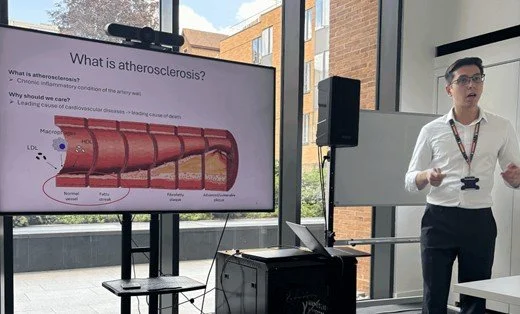
Dr Chambers motivating his structured phenotypic models with atherosclerosis
The second talk was given by Dr Keith Chambers from the Ludwig Institute for Cancer Research. Focusing on atherosclerosis, a major cause of death worldwide, he presented two mathematical models he developed during his DPhil to better understand how immune cells called macrophages behave in the early stages of the disease.
The first model looks at the macrophage population within a system of ordinary differential equations. The results show that the relative concentrations of low-density lipoprotein (LDL) and high-density lipoprotein (HDL) in the blood strongly shape macrophage behaviour and ultimately whether there is a healthy or unhealthy outcome.
The second model uses a differential equation that includes information on plaque depth to match imaging data: whilst LDL accumulates deep in the artery wall, the macrophages become stuck at shallower depths. Encouragingly, this model agrees with the data observed in real tissue, with the assumptions that in increased lipid content, macrophages are much less mobile and more likely to die.
Dr Tara Trauthwein
Approximation Results for Large Networks
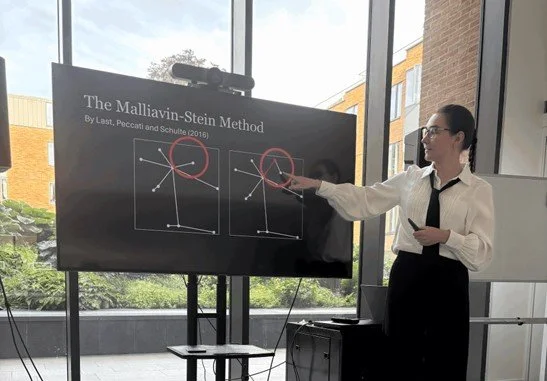
Dr Trauthwein outlining the Malliavin-Stein method on networks
The third talk, given by Dr Tara Trauthwein from Oxford, explored how large, complex networks can be understood through the lens of probability theory. Focusing on idealised models, like those that mimic internet structures or spatial networks, she demonstrated how certain global properties, like the total length, or "cost", of a network can often be well-approximated by Gaussian distributions. This is possible thanks to central limit theorem-style arguments, where networks are broken into local regions that behave almost independently.
A key part of her talk concerned the Malliavin–Stein method, a powerful probabilistic tool used to quantify how adding small disturbances, like the addition of vertices in a spatial network, affects the overall structure.
By measuring how sensitive the network is to such changes, her team can assess how local these effects remain and how robust a network becomes as it grows. These ideas have implications well beyond networks themselves, with potential applications in stochastic geometry and broader questions of spatial complexity.
Isaac Newell
The Gauss Equation for Isometric Embeddings of Regularity in W1+2/3,3∩ C1
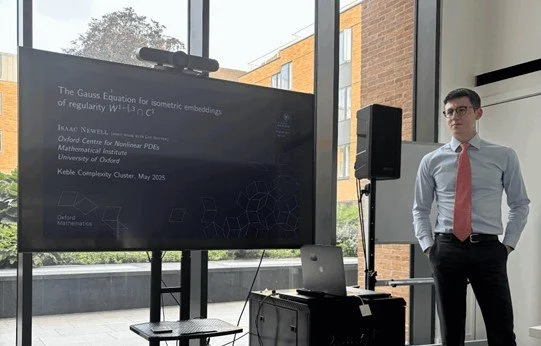
Issac Newell introducing the group to Isometric Embeddings of Regularity
The final talk was given by Isaac Newell, a third-year DPhil student in the OxPDE group. He talked about the isometric embedding of a smooth Riemannian surface in the 3D Euclidean space, a tool that lets us visualise otherwise abstract geometric objects. There is a well-known result that, when the embedding is twice continuously differentiable, the image of the surface in the Euclidean space satisfies the Gauss equation, 𝐷²𝑓=𝐾𝑔(1+|𝐷𝑓|²)², where 𝐾𝑔 is the Gaussian curvature of the manifold.
Isaac presented joint work with Luc Nguyen showing that if the embedding is both continuously differentiable and in the Sobolev space W3/5,3, then the image surface satisfies the Gauss equation in a weak sense. Then he moved on to discuss whether the Gauss equation still holds when the embedding belongs to other Sobolev spaces W1+s,p for s chosen between ½ and 1 and p chosen arbitrarily. He stated a removability theorem to demonstrate that the Gauss equation holds for a range of s and p, while he also gave some counterexamples where the Gauss equation doesn’t hold, raising the question of whether there is a borderline in s and p between the positive and negative cases. The talk ended with a discussion about whether it is feasible to show such a borderline.
Based on a report by Joshua Moore, Thomas Quinlan and Ziyang Zheng.