Library Exhibition | Stained

Leona Stewart, College Librarian, writes:
Stains from questionable sources? The unintentional and intentional staining of books can tell us a lot about where they have come from. In association with Keble Arts Festival, Keble library team curated Stained, a mini-exhibition of medieval manuscripts and early printed books, tracing their history through the marks left behind.
By nature of the theme, we were able to explore items rarely placed on display. From bookworm damage to amateur ‘mending’, the exhibition spanned centuries and invited visitors to look beyond the text to the evidence of use.
The display was organised around three loose themes:
Oops
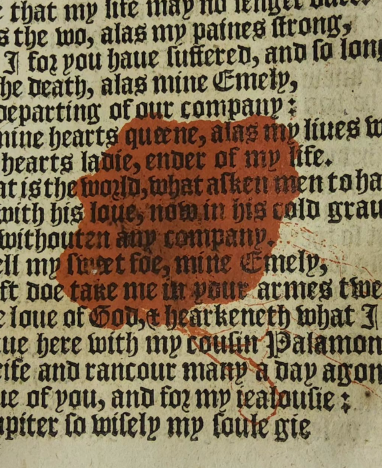
The stains, smudges and production slips that were never part of the plan, featuring: The Works of Geoffrey Chaucer [1687]
Is that blood?! No, but it does look alarmingly convincing. The dramatic red mark on this page is rubrication ink, traditionally used to highlight headings or important passages. This edition, the last Chaucer printed in black-letter (Gothic) type, contains no red text at all, so why the sanguineous stain? A likely explanation is a simple printing-house accident; a pot of ink knocked in a crowded workshop.
However, the stain splashes across the death of Arcite in The Knight’s Tale and invites speculation. A coincidence or a printer with a sense of drama?

This one is mine!
How book owners would claim their collections, including: Expositio Hymnorum [ca. 1476]
All right-thinking citizens would abhor the vandalising of books… right? Yet here we have a “peculiar mania” for doing just that. This 15th century book of hymns has been grangerised, the Georgian and Victorian hobby of extra-illustrating books with cuttings from other volumes. Its owner, John Bellingham Inglis (1790-1870), was prolific in his enthusiasm for book remixes. Several of Inglis’s books exist in Oxford Libraries. All bear the same tangerine end-leaves, and all have been grangerised with neatly fragmented images from other books.
Objects of use
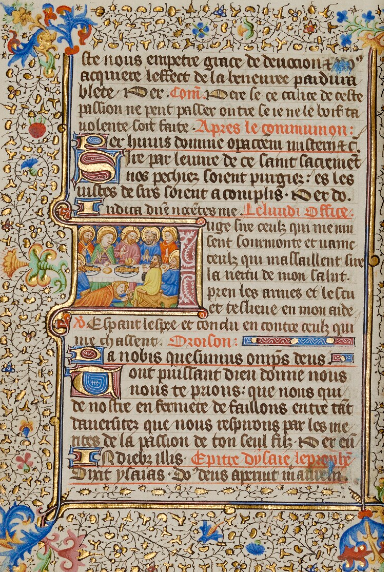
Reading and engaging with a text, and how we preserve what is left, highlighting: Missal in French (Dominican Use) [15th Century]
Richly illuminated by the Master of Sir John Fastolf, an anonymous 15th century illuminator, this missal shows pigment wear from centuries of handling and light exposure. This deterioration is precisely why this item was on display as a high-quality digitisation, a project made possible, with thanks to alumnus Alistair Tucker (1955 Jurisprudence), in 2025-26. By capturing every page in detail, we are able to reduce the handling of the original while establishing a new avenue for study and enjoyment.
Everyone is very welcome to explore our digitised manuscripts on the Digital Bodleian.
Stained was curated by College Librarian, Leona Stewart, and Deputy Librarian, Liz Fleetwood.